
⇒日本語ページはこちらをクリックしてね!
The coldest month of winter was chosen as the New Year, the time when a new year began.
The day when the moon disappeared completely from the night sky marked the first day of the year. From that night on, the moon would slowly grow round again.
The hours of daylight were very short then, but from this day forward, they would little by little grow longer as summer came closer.
The people of Fujimi Village joined their hands and prayed toward Mount Fuji, which could be seen far away.
They asked the mountain for daily safety, a good harvest from the fields, and a great catch of fish from the sea throughout the year.
Soran had never seen his mother, Tomo, pray toward Mount Fuji.
In Soran’s home village, people also worshiped Mount Fuji, but Tomo never did.
Some people did not like that she did not do what everyone else did, but Tomo never changed her mind.
“The God I pray to,” she once told Soran gently,
“is the God my older brother taught me about in my mountain village long ago.
That God made the heavens and the earth, so we cannot see Him with our eyes.
My brother always said that God teaches us not to depend on things we can see—things made of stone, wood, or earth.
So when I pray, I close my eyes and think of God in my heart.
Then a quiet, beautiful rainbow-colored light appears inside my mind.
And there, I say ‘thank you,’ or I make my wishes.”
Soran did not fully understand his mother’s words, but he began to think about the God she believed in.
He wondered if one day he might meet this “rainbow God” too.
Fourteen days after the New Year began, the sumo tournament was held.
Many people gathered from the four nearby villages, because this year Fujimi Village had been chosen as the place for the event.
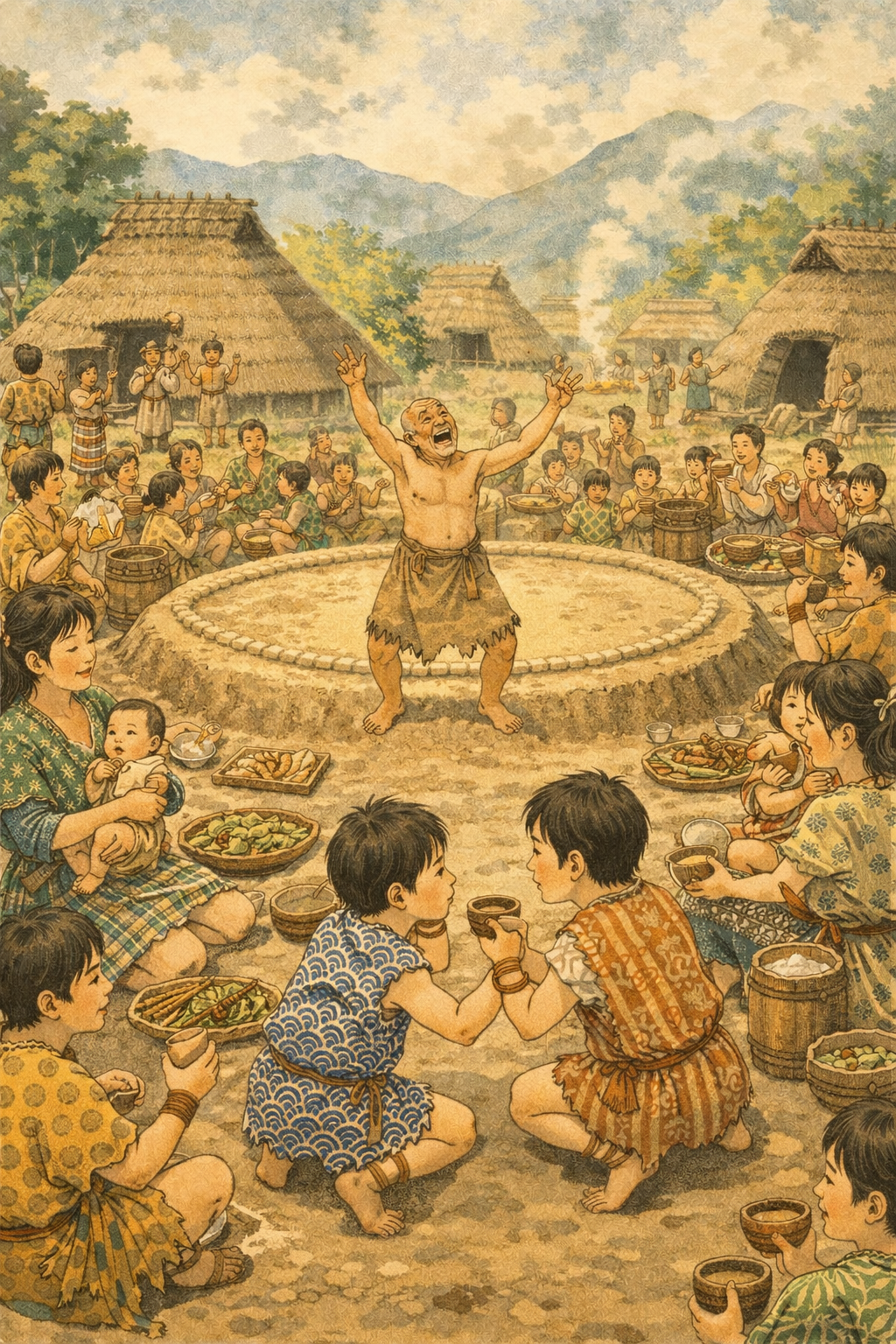
Bonfires were lit all around the village square, and the place quickly filled with people.
Everyone was in high spirits—laughing, singing, and smiling.
Men with red faces from drinking shouted loudly, and some older men danced happily with their upper bodies bare.
In the center of the square stood a round earthen ring for sumo, covered by a tall grass roof so it would not be damaged by rain or snow.
The wrestlers were very serious.
They warmed up their bodies, breathing out white clouds of air in the cold.
They wore strong sumo belts around their waists, but their upper bodies were bare.
First came the baby sumo matches.
Two babies, each held by an adult, faced each other.
The rule was simple: the baby who cried the loudest first won.
Babies held by strangers usually cried right away, and the adults watching burst into laughter.
Some babies did not cry at all—and some even laughed loudly—making the adults laugh even more.
Next came the children’s sumo for those nine years old and under.
After that was the youth sumo for ages ten to fifteen.
Last of all was the adult sumo.
Soran was to take part in the children’s sumo, and he was very nervous.
He felt so scared that he wanted to run away.
But then he remembered his father.
His father had been a brave man, a champion many times at the sumo tournaments in their home village.
For his father’s sake, Soran decided he would not be a coward.
Fujimi Village’s first opponent was Sayama Village, a village a little farther up in the mountains.
They had chosen five children, all big and strong.
Masato, who was slim but muscular, whispered to Soran,
“Being big isn’t enough. You need a steady stance.”
The first match was Masato’s.
His opponent was the biggest child of them all—big enough to wrestle in the older group.
At the signal “Ready, begin,” Masato quickly pushed against the boy’s chest.
The boy was driven to the edge of the ring but managed to hold on and reached for Masato’s belt.
At that moment, Masato slipped aside and pushed hard against the boy’s back.
The boy cried out and put his hands on the ground.
Masato won.
The people of Fujimi Village cheered with joy.
The second match was Toshi’s turn.
Though small, Toshi was quick and clever.
At the signal, he darted left and right, and in an instant moved behind his opponent and pushed him out.
Toshi won.
The third match belonged to Taro.
He was not very big, but he had a sharp throwing technique.
After the signal, he stepped back slightly and dodged as his opponent rushed forward.
The opponent grew impatient and lunged—and just as Taro planned, he threw him down.
Taro won.
Now it was Soran’s turn, the fourth match.
His opponent was also big, probably nine years old.
Soran could clearly hear his own heartbeat. His mouth felt dry.
“Ready, begin.”
As soon as he heard the signal, Soran felt his fear fade away.
He remembered his father’s words:
“Whether you win or lose, give it all you have. That is enough.”
Soran lowered his stance and waited.
He knew that standing too tall made him easy to push over.
His opponent also lowered his stance and waited calmly.
“He’s strong,” Soran thought.
They crashed chest to chest and grabbed each other’s belts.
The crowd’s cheers grew louder.
“Hang in there!”
“Go on, little one!”
Soran held on tightly as his opponent tried to shake him from side to side.
When he was pushed to the edge of the ring, Soran made a bold move and tried to throw the other boy backward.
Both fell out of the ring almost at the same time.
The judge paused, then declared the boy from Sayama Village the winner.
“Ohhh!”
Protests rose from Fujimi Village.
Masato and the others shouted, “Soran won!”
Soran stood up, returned to the ring, and said clearly,
“I lost. I think I touched the ground first.”
Suddenly, his mother Tomo shouted loudly,
“Soraaaan! You did great! You were wonderful!”
Everyone turned to look at her.
Tomo waved her arms wildly, and everyone burst out laughing.
“Well done, little one,” people said warmly.
The final match was Katsuyama’s.
At the signal, he threw his opponent out of the ring at once.
Fujimi Village won four to one.
After that, the children from Shiki Village by the sea and Tokoro Village in the south competed.
Tokoro Village had been last year’s champion.
This year too, Tokoro Village won, three to two.
At last came the final match: Fujimi Village versus Tokoro Village.
The results were:
- First match: Masato (Fujimi) won
- Second match: Kohei (Tokoro) won
- Third match: Hiro (Tokoro) won
- Fourth match: Soran (Fujimi) won
- Fifth match: Katsuya (Fujimi) won
Yes—three to two.
This year, the children of Fujimi Village were the champions.
Soran played a huge role.
The cheering from Fujimi Village was tremendous, because if Soran had lost, Tokoro Village would have won.
In the final match, Soran was once again pushed to the edge of the ring—but this time, he threw his opponent beautifully out of the ring.
After that, people called him by a new nickname: “Uchchari,” the great thrower.
After the tournament, everyone ate, drank, sang, and danced together.
As the sky grew dark, the visitors returned to their villages.
The full moon shone brightly, lighting the ground beneath their feet.
Please leave a comment!