
The warm sunshine of spring melted away the heavy snow at last.
In the forest, the trees began to stretch out their new leaves all at once. The bright green of young leaves makes people’s heart dance with joy. It is the color of life. From the brown earth and the dark branches of trees, fresh green life began to appear.
Saita Village was a new settlement that had been built by people from Tomo’s hometown, Sak Village. Only four families lived there so far. Soon more houses would be built, and more people from Sak Village would slowly move there.
Tomo and Soran had been staying in a brand-new house for one week.
Today was the Sabbath again.
“Soran! Come out! I’ll teach you how to shoot a bow and arrow!”
It was Takeru calling him—the boy who loved archery and whom Soran had met when he first arrived in the village.
Soran looked at his mother. When she nodded, he happily ran outside.
The sky was bright and blue. For children, it was impossible to stay inside on such a beautiful day. A warm breeze blew across the village.
All the houses in Saita Village looked new. They were built close together on land near the eastern shore of the sea. Two large oak trees stood at the southern entrance of the village.
Many trees around the village had been cut down, and the cleared land was now used as fields where millet and other grains were planted. To the south was the mouth of a river flowing into the sea.
On the west side of the village stood many chestnut trees. Beyond them stretched a deep forest. A path led through the forest to huts where charcoal was made.
There was also a small hill nearby. If you climbed it, the view must be beautiful.
To the north, the black sandy beach stretched far along the coast.
“Today is the Sabbath, right?” Soran asked. “Is it okay to shoot arrows?”
Takeru was already bouncing with excitement.
“Well… just practice should be okay, I think,” he said with a big grin.
Then Soran noticed another boy sitting quietly on a tree stump. It was the same boy he had met when he first arrived in the village—Satoshi.
“Actually… it’s not really allowed,” Satoshi said. “But the village chief pretends not to notice.”
Sometimes Satoshi’s words came out slowly, but he didn’t mind at all. He believed that when he grew up it would get better. Until then, he simply spoke in his own easy way.
“Our new chief, David, suggested a rule a long time ago,” Satoshi continued. “No work on the Sabbath. Everyone has followed it since the days of Sak Village. People say that rule made everyone happier. I think so too. On the Sabbath we have time to think—not about food or things we own, but about God. And singing and dancing are allowed. That’s why it’s fun.”
Satoshi seemed very happy about the Sabbath.
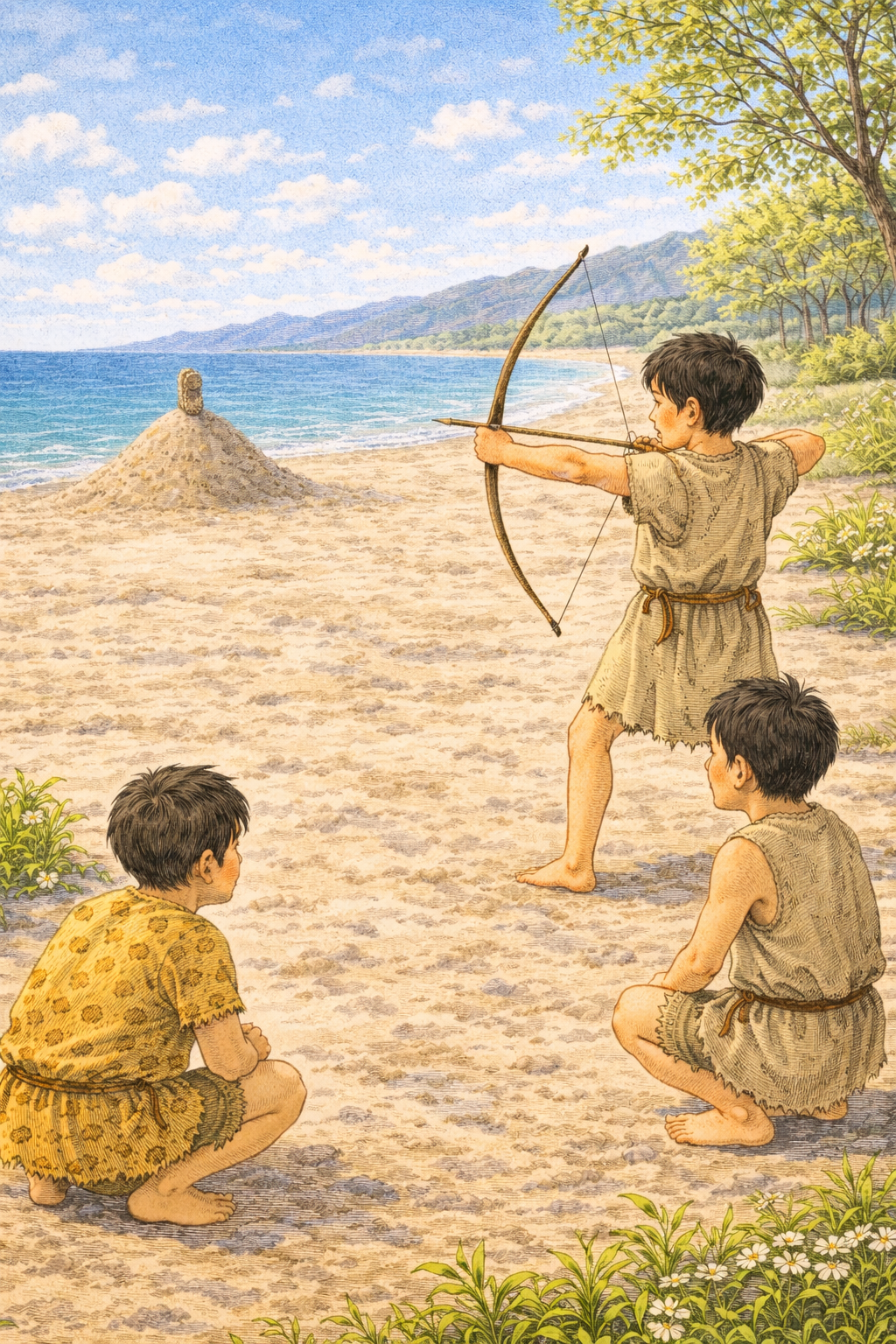
The boys walked together down to the beach.
If they practiced there, it would be easy to find the arrows in the sand. Not a single arrow could be wasted.
“First, we make a target,” Takeru said.
He began piling sand into a small mound. Soran and Satoshi helped, and soon the mound was about as tall as their waists.
“This will be the target,” Takeru said.
He took off one of his straw sandals and placed it sideways near the top of the sand pile.
“We’ll start from about ten steps away.”
“Watch this,” Takeru said.
He slowly set an arrow on the bowstring.
Whizz!
The arrow flew straight and stuck right in the middle of the sandal.
“Hit!” Satoshi shouted.
“Wow!” Soran cried.
“Well… not bad,” Takeru said proudly. “But if I ruin my sandals too much, my mother will scold me.”
He stuck out his tongue playfully.
Next it was Satoshi’s turn. His arrow missed the sandal, but it sank deeply into the sand mound.
Now it was Soran’s turn.
He had never used a bow before. In his old village, boys were not allowed to use bows until they turned ten. And to be honest, Soran did not like killing animals with arrows.
But like any boy, he had always dreamed of shooting arrows skillfully.
With a sand target and a sandal, he had nothing to worry about.
“Wow… it takes more strength than I thought!” he said while pulling the bow.
The bow shook in his hands.
“Here goes!”
He released the arrow.
Whoosh!
The arrow flew in a completely different direction and splashed into the sea.
“Hit!” Satoshi shouted loudly.
“A direct hit—on the sea!” Takeru laughed.
“Yes! I caught the ocean!” Soran shouted proudly.
The three boys burst into laughter.
When the boys returned home hungry, the village families were gathering for a meal.
Because it was the Sabbath, no cooking was done that day. Everyone had brought food prepared the day before. All the villagers gathered in the village square.
It was a welcome celebration for Tomo and Soran.
David, the new village chief, stood up to speak.
“I never thought I would see my sister Tomo again. Yet she has returned to us—with her wonderful son. No matter how much I thank God, it will never be enough. I feel as if I have been lifted up to heaven. It is as if the happy days of our youth have returned.”
“Chief David looks younger!” someone shouted.
“That’s right,” David laughed. “I feel ten years younger! No—perhaps fourteen years younger, to the day when the people of Sak Village saved my life. Tomo found me lying in the snow. Her father, the village chief, raised me as if I were his own son. That day I promised to give my life for the village. Today I promise it again. I want Saita Village to become a true village—a safe and happy place where the people of Sak Village can come to live together in peace. A place like the Kingdom of God.”
“We’re counting on you, David!”
“You’re a fine man!”
“Hahaha!”
Everyone laughed happily.
David was taller than anyone else in the village. His body was strong and muscular. Soran noticed how thick David’s arms were and stared in amazement.
The next day he would learn why.
Early the next morning, David came to fetch Soran.
“Soran, will you help me today?”
Tomo smiled and said, “Go on. Have a good day.”
Soran followed David north along the beach. The sand there was darker than usual.
“Do you know why the sand here is so black?” David asked.
“I’m not sure,” Soran answered honestly.
“Far to the north, a big river flows into the sea. In the mountains upstream there are rocks containing copper and iron. Rain and rivers break those rocks into tiny pieces. The metals flow down the river and wash up here on the shore.”
David reached into the bag slung over his shoulder and carefully took out a rock about the size of both his hands.
He rolled it across the sand.
Immediately tiny black grains stuck to the rock. They clung together like the spines of a sea urchin.
“Iron sand,” David said. “This rock is called magnet stone. It pulls the iron sand toward it. With this, we can gather iron sand and make iron.”
“It’s beautiful,” Soran said. “Can I touch it?”
“Of course.”
When Soran touched the rock, the tiny iron grains fell away softly.
Next, David took Soran to a large work hut on the north side of the village.
Inside were many strange tools Soran had never seen before.
David lit charcoal in the furnace and pumped air into the fire using a tool called bellows. The fire burned hotter and hotter. Soon he placed a piece of iron in the flames.
When it turned red with heat, he grabbed it with iron tongs and placed it on a large block of metal called an anvil.
Then he began hammering.
Clang! Clang!
The loud ringing sound made Soran jump and cover his ears.
David glanced at him with a smile and swung his hammer again and again with his powerful arms.
Soon he began to sing in a strange rhythm as he worked.
“En-ya! Kora-ya!
En-ya! Kora-ya!
Dokkoisho!
Dokkoisho!”
The words sounded funny, but Soran quickly learned them and joined in.
“En-ya! Kora-ya!
En-ya! Kora-ya!
Dokkoisho!
Dokkoisho!”
With every beat of the hammer—
Clang! Clang!
Sparks flew.
Soran watched with wide eyes as the lump of iron slowly stretched and flattened.
Clang!
Clang!
Clang!
It felt like watching a kind of magic.