
The path up the hill began just behind the house.
At first, it was wide and firmly packed, because children leading sheep and goats walked there every day.
Halfway up the hill, the land opened into grassy pastures, perfect for feeding animals.In each household, young children were given this job.
Families without children asked their neighbors’ children to take their animals along.
In return, they paid a small reward or shared vegetables and fruit from their fields.
Partway up, the path split in two.
The left path led into the pasture, while the right path climbed all the way to a hilltop with a wonderful view.
On clear days, you could see all of Nazareth spread out below, and far beyond it, the western horizon where the great sea lay.
To the north rose Mount Hermon and the mountains of Lebanon.
If you were lucky, you could even catch a tiny sparkle of sunlight reflecting off the Sea of Galilee.
To the south, Mount Carmel stood tall, its gentle slopes like the graceful curve of a beautiful woman’s neck.
You could not go there on the Sabbath, but on ordinary days, from the far side of the hill , you could see the Jordan River and wide open plains.
Nazareth was truly a place of beautiful views.
Luke climbed the hill for the first time with a heart full of excitement.
Small purple flowers he had never seen before grew in clusters along the slope.
At the fork in the road, he turned right and headed for the top.
He soon found a spot halfway up that he liked best—it looked out over the town of Nazareth.
There were rocky places where he could sit down and gaze quietly at the scenery.
The breeze felt good on his skin.
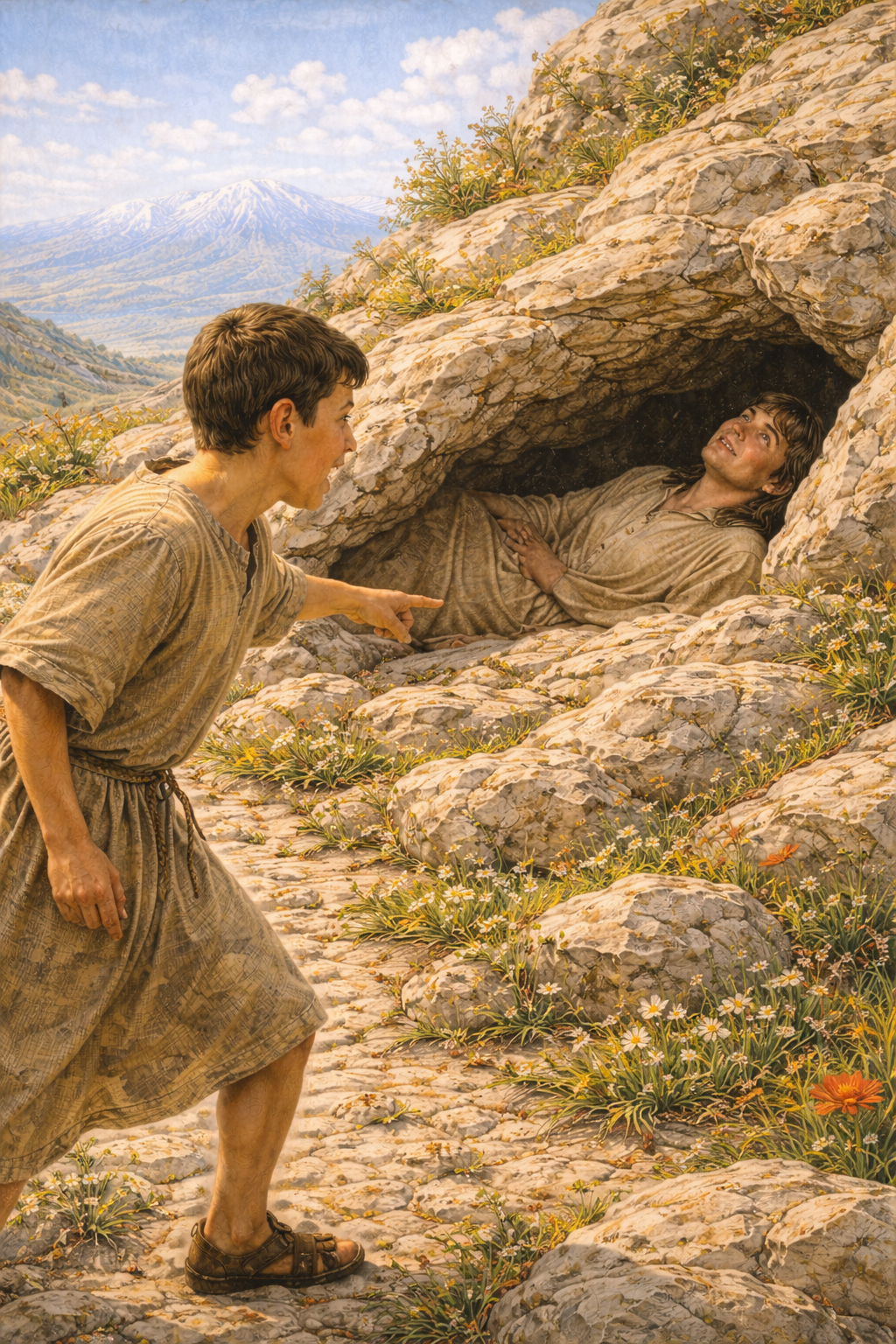
He slipped into a hollow where a rock cast a cool shadow.
It felt like a secret hideout.
Luke stayed there for a while, very still.
He felt as if he had been here before.
Next time, he thought, I’ll bring Theophilus too.
He had named his cat after his best friend.
As Luke searched for another rocky hollow, he suddenly froze.
Something was there.
In the dark shadow ahead, it seemed as if something was breathing.
Luke stared carefully—and then a human face appeared.
It blinked.
Suddenly, it stood up.
A person stepped out.
He wore clothes the same color as the rocks, and his head was covered, so all Luke could see was part of his face and the gentle rise and fall of his chest.
The person spoke.
“Hello. You’re Luke, aren’t you? Welcome to the hill.”
Luke was so surprised that no sound came out.
“Oh! Did I scare you? I’m sorry, I didn’t mean to,” the boy said, pulling back his head covering.
He was about Luke’s age.
The wind stirred his long hair.
“It looks like you like this rocky place too,” the boy said.
“This is one of my favorite spots. I come here to think about the brave heroes and people of faith from long ago.
I imagine rocks where David hid while he was running away, or the rock Moses struck to bring out water.
Doesn’t that rock over there look like Mount Sinai?”
Luke noticed something else, too.
He understood every word the boy was saying.
And that was because the boy was speaking Greek.
“You can speak Greek,” Luke said at last.
“Yes,” the boy replied.
“My father taught me—the human one,” he added with a smile.
“He’s a carpenter, very skilled. People from many towns ask him for help, and I go along sometimes.
More and more people around here speak Greek, so I learned it naturally.”
Luke asked the question that had been on his mind.
“Are you the one they call the ‘Singer’?”
“Hahaha!”
The boy laughed loudly.
Then he stood on a rock, took a deep breath, and began to sing softly in Hebrew.
His voice grew stronger and echoed across the hill.
How lovely is Your dwelling place,
My soul longs for Your courts.
I will sing praise to Your glorious Name,
I will sing praise.
One day in Your courts is better than a thousand.
I love Your house, O Holy One,
I love Your house.
“It’s a good song, isn’t it?” the boy said.
“I wrote it while thinking about my Father’s house in Jerusalem.”
“Does your father have a house in Jerusalem?” Luke asked.
“Hahaha!”
The boy laughed again, tears in his eyes.
“Yes—my Father’s house.
Come with me during the next festival. It will be a wonderful journey.
My mother says your mother and she were best friends as children.
They always went to the festivals together.
Next time is the Festival of Booths—the Festival of Light.
Jerusalem will glow with lamps.
At night, it’s so bright, it looks like daytime…”
The boy gazed up at the sky, closed his eyes with a peaceful smile, and became still.
Only his breathing gently moved his chest.
Luke didn’t fully understand, but he stood up too and closed his eyes.
He felt the warm sunlight.
He smelled summer grass.
A cool breeze brushed his skin.
When he opened his eyes, his mother’s town spread out before him, fields shining all around it.
I’m in my mother’s land, he thought.
Tears quietly slipped down his cheeks.
Luke listened as the singing boy spoke and sang.
The boy even showed him where a rock owl nested, its big round eyes blinking cutely.
Luke heard the call of a rock partridge, though he couldn’t see it.
“Chuk, chuk, chuká—chako, chako, chako!”
The boy explained that the rock partridge was a beautiful bird, like a dove but larger, with bright orange around its beak and eyes.
Luke understood now why the boy sometimes fell silent—he was speaking to God in his heart.
“Oh! I have to help my mother,” the boy said suddenly, running down the hill.
As Luke watched him go, he realized he had forgotten to ask the boy’s name.
And so, on that hill, Luke’s true journey quietly began.
Please leave a comment!