
“Yaa-hooo!”
Tomo, Soran’s mother, called out in a loud voice.
“Yaa-hooo!”
The same word echoed back through the sky.
It was a mountain echo.
Soran copied her.
“Yaa-hooo!”
The mountains answered again.
“Yaa-hooo!”
Tomo and Soran were climbing a low mountain near Fujimi Village.
They were looking for young tree buds and wild plants that could be eaten.
“It’s still cold, but some early trees and grasses are already putting out their spring buds.
Look—this is bracken fern.”
Tomo showed Soran a green plant with a tip curled tightly like a spiral.
“Oh! The slippery one!”
Soran recognized it right away.
Back in his old village, his mother used to gather it every spring, and the family ate it together.
But this was the first time he had seen it growing on a mountain slope.
“Wow! There’s some over there too! And here!”
Soran was so happy that he eagerly picked the bracken growing straight up from the ground.
Each time he snapped one off, it made a small crack sound.
“Soran, don’t pick it from the root,” Tomo said gently.
“If you do, there won’t be any left for next year.”
“Yes,” Soran replied.
Along a small stream where snowmelt flowed, many butterbur buds were sprouting.
They picked the bright green buds poking out of the brown soil.
They were cooked with miso and eaten, but they tasted a little bitter—
a flavor for grown-ups.
Soran didn’t like them very much.
While searching near the stream, Tomo suddenly cried out happily.
“I found it! Mountain wasabi!
This is Grandpa Seitaka’s favorite.
With soy sauce, it’s really delicious.
He’ll be so happy.”
“I know,” Soran said.
“But it’s really spicy, right?
Why do grown-ups like bitter and spicy things?”
Looking at the thick white root Tomo dug up, Soran tilted his head.
Tomo smiled.
“That’s a good question.
I bet Grandma Yuka knows the answer.
Let’s ask her later.”
Grandma Yuka had a vegetable garden just behind the house.
She planted and grew edible plants and trees she gathered from the forest.
After returning from the mountain, Soran and Tomo boiled the bracken in a clay pot
and chatted with Grandma Yuka.
“Hahaha,” Grandma Yuka laughed.
“This is more like a flower garden than a vegetable garden.
I love pretty flowers, so whenever I find a plant that blooms,
I plant it here.
In spring, they all bloom at once—so beautiful!
People from the whole village come to see them.
We spread mats and have a flower-viewing picnic.
Butterflies come too—it’s very lively.
The men mostly just drink sake, though.”
Then Grandma Yuka lowered her voice and whispered a secret.
“I’ll tell only you, Soran.
During flower viewing, the Koboshi-sama come to play too.”
“Koboshi-sama?” Soran asked.
“Yes,” she said, holding up her little finger.
“They’re small people, only about this tall.”
“They only show themselves to people with pure hearts.
Many villagers have seen them.
I’m sure you and Tomo will see them too.”
Just then, they heard Grandpa Seitaka’s whistling.
He was always either whistling or singing.
“Ho—i, ho—i! I’m home!”
Tama the cat, who had been sleeping curled up by the hearth, meowed and rubbed against Grandpa’s legs.
“Ho—i, Tama. I brought you a present.”
Grandpa gave Tama a branch of silver vine.
Tama began to purr loudly.
“Ho—i, your favorite,” Grandpa chuckled.
“She didn’t care for it as a kitten,” Grandma said,
“but I guess you start to appreciate silver vine as you get older.”
Soran remembered the talk he’d had with his mother in the mountains and asked,
“Grandma, why do grown-ups like bitter and spicy foods?”
“That,” Grandma said slowly, “is God’s punishment.”
“Huh? God’s punishment?”
Grandma told them a story.
“Long ago, people were all good.
But one day, they disobeyed God and did bad things.
So God made it so that each time someone does something bad,
they begin to like bitter and spicy tastes.
That’s why when people lie, are mean, hurt animals, or make messes,
they slowly stop minding bitter and spicy flavors.
By the time people grow up, they’ve all done something bad—
so they end up liking those tastes.
People who do lots of bad things might even enjoy foods so bitter or spicy
that a good person’s tongue would go numb.”
Grandpa Seitaka muttered,
“Maybe I’ve done lots of bad things too.
I love bitter foods now.
Well… growing up isn’t all good things, that’s for sure.”
With that, he happily ate the mountain wasabi Tomo had gathered.
“Ho—i! Spicy—but tasty!”
Tama, dizzy from silver vine, purred and rubbed against Grandpa’s crossed legs.
The next morning, the sun shone brightly over the forest and the sea.
Soran’s friend Masato came to pick him up.
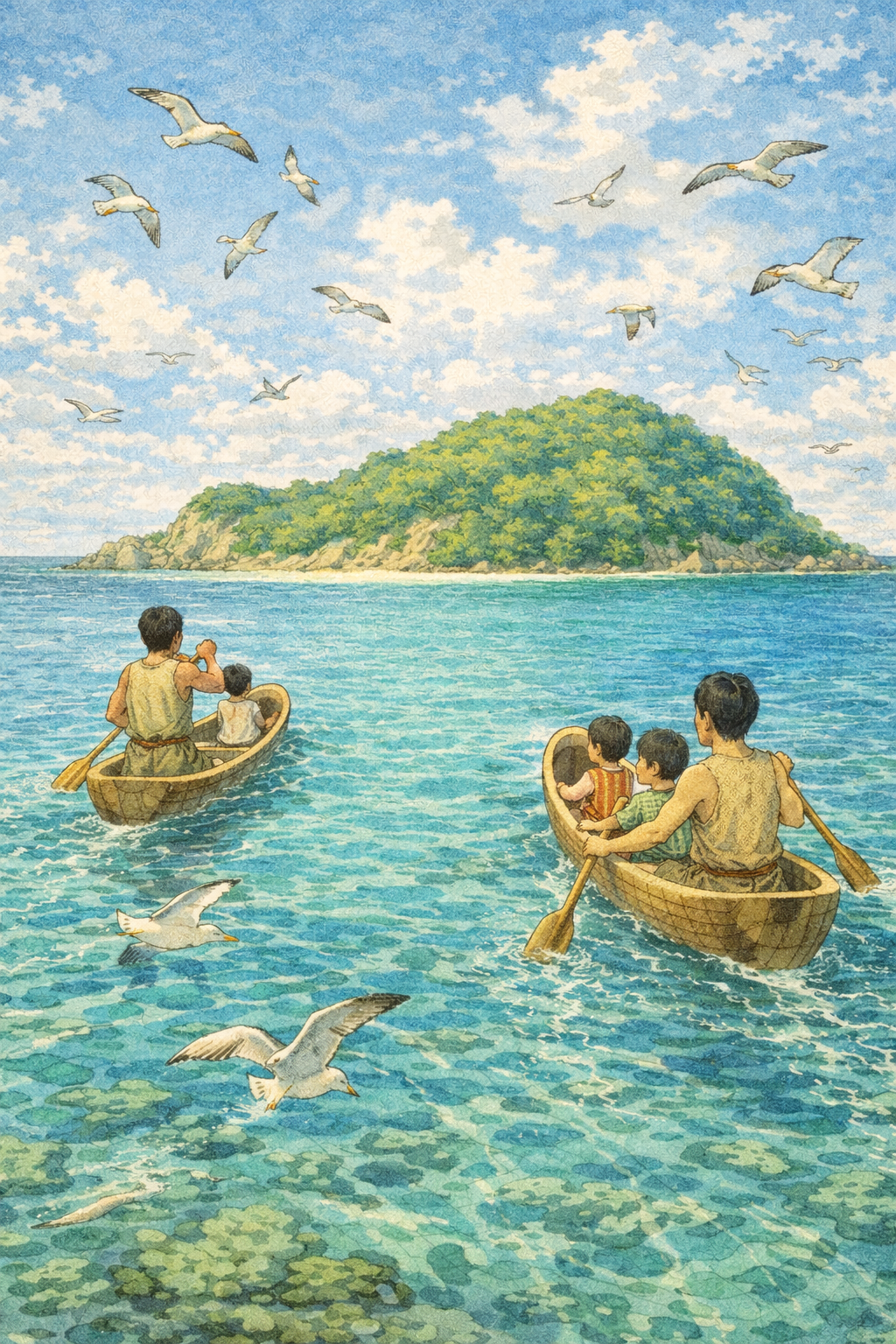
They were going to Urawa Island by log boat.
Masato’s father was a skilled fisherman.
On clear days, he went out to sea almost every day.
Fishing nets were set near Urawa Island, and today Soran could come along.
Their friend Katsuya joined them too.
Two log boats glided quietly over the sea.
The sky stretched wide and blue to the far southern and eastern horizons.
To the north and west, snow-capped mountains stood clearly.
Seagulls flew after the boats.
“It’s beautiful,” Soran whispered.
No one answered—
as if speaking would spoil the moment.
As they rowed, the fathers began to sing:
Hey, hey, little seagull,
Calling from the sky so blue,
Won’t you come and marry us?
Fish every day to fill you up,
A warm place to sleep each night,
And best of all—we’re good men too!
At the last line, the three boys shouted along:
“And best of all—we’re good men too!”
On the island, only the children got off to play while the fathers checked the nets.
“Yaa-hooo!”
Soran ran across the beach.
Masato and Katsuya followed, laughing.
They raced, wrestled, explored a cave full of bats, and shouted echoes again.
“Why do you say ‘yaa-hoo’ so much?” Masato asked.
“My mom says it’s a word for calling God,” Soran replied.
“God’s name is Yaha.”
“Yaha, huh…”
Soon Masato was shouting it everywhere.
By the time they returned to the village,
everyone had learned the word.
✨ Feel free to leave a comment! ✨