
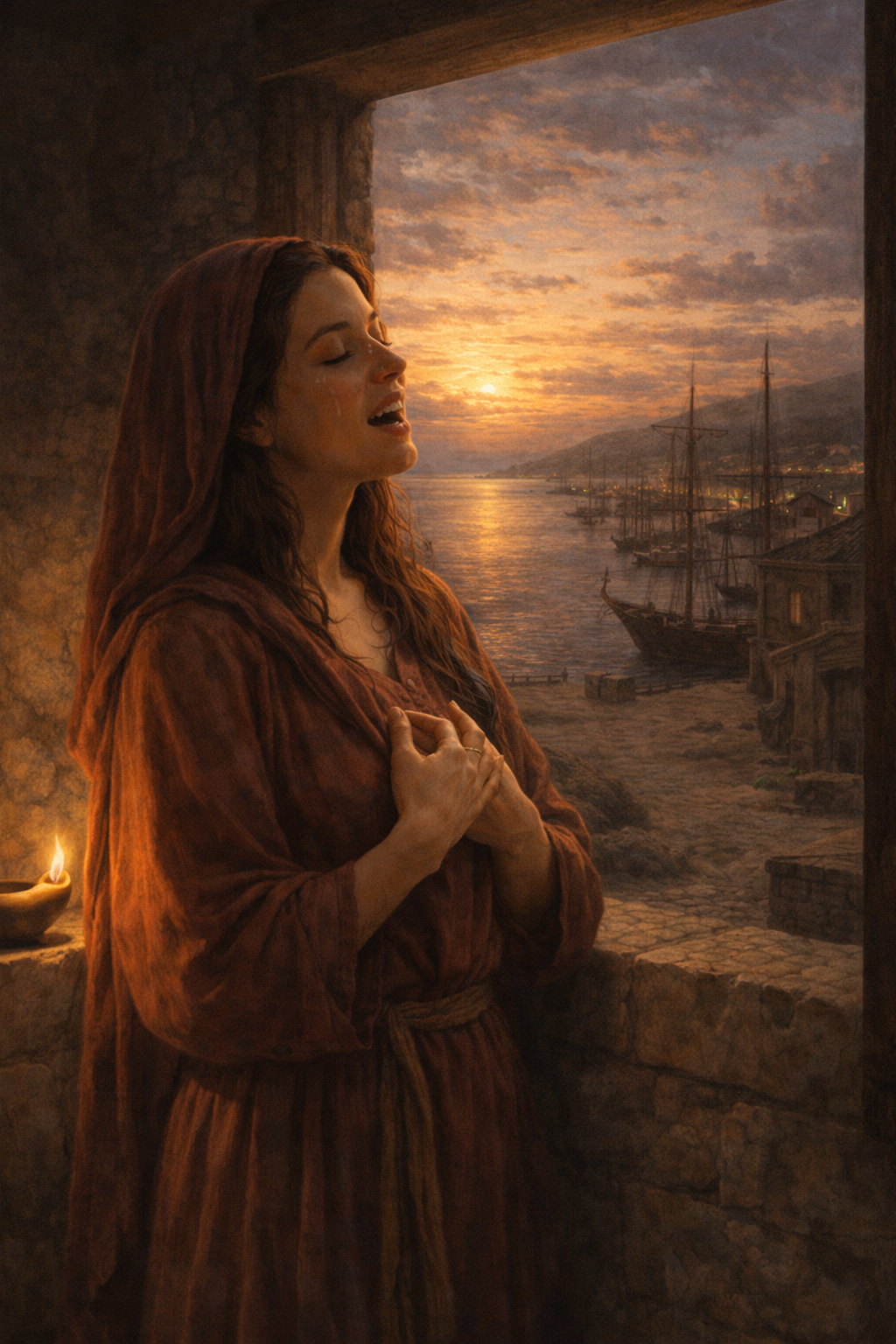
“Mom, I wonder how she’s feeling today.”
The boy opened the door to the large upstairs hall where his mother usually waited.
“I’m home,” he said softly.
Comfortable sofas were arranged across the marble floor. On top of several ceramic lamps, small flames flickered, fed by linen wicks. The gentle light trembled, as if it were breathing.
“Mom?”
There was no answer.
Just as he placed his hand on the stair railing to climb up to his parents’ room on the third floor, he heard his mother’s voice drifting down from above. She was singing. It was not one of the Greek songs she usually sang. The melody was unfamiliar, mysterious, and strangely beautiful.
“This is a song from my mother’s homeland,” the boy felt at once.
It was a song in Hebrew. It was often sung on the Sabbath in the small synagogue of the town where his mother had grown up. It was a song of praise to God.
As the boy climbed the stairs to the third floor, he listened closely. At first, his mother’s voice was soft and fragile, but little by little it grew steadier and stronger. It was as if water that had long been held back was finally allowed to flow free. When he gently opened the door to the third-floor room, he saw his mother standing by the window in the dim light. The last glow of evening shone on her beautiful profile. A breeze from the Aegean Sea stirred her long, carefully braided black hair. Her clear singing voice filled the room and lingered on.
The boy’s name was Luke. He was twelve years old.
He had been born to a Greek father and a Jewish mother. His parents’ love had crossed the boundaries of nations and traditions. His father, Alex, and his family had warmly welcomed the young and beautiful bride. Alex came from a wealthy family, well known in Troas for producing many physicians.
Luke’s mother, Dinah, however, was the daughter of a poor Jewish craftsman. Her parents could not accept that their daughter would leave her homeland and the God of her people to become the wife of a foreign man. They abandoned their metalworking business, which had finally begun to succeed in Troas, disowned their daughter, and returned to their homeland.
Dinah sank into deep sorrow. In time, however, her naturally cheerful spirit returned, and she tried her best to adapt to a Greek way of life. She was a lively woman who was liked by everyone. Because she had grown up in Troas from childhood, she spoke Greek with ease. After marrying her Greek husband, a physician, she made a quiet decision to “forget” her native language, Hebrew.
Soon, her son Luke was born, and Dinah enjoyed a comfortable and happy life together with her kind husband and his family. Everyone hoped that Luke would one day become a doctor. But life tested Dinah once again. Her husband died suddenly during a terrible outbreak of disease.
After that, Dinah became quiet, almost like a different person. She avoided meeting people and spoke very little. For Luke, too, his father’s death felt unreal. Day after day, he lived with a heavy pain in his chest, as if a great stone had been placed there and would not be removed.
Alex, Luke’s father, had been a learned and thoughtful man. He did not believe in the very human-like gods of Greece.
“They’re just stories,” he used to say. “The true God is somewhere else. Perhaps your mother’s God is the true God.”
Luke often wondered what kind of God “his mother’s God” might be.
The song Dinah sang in the fading evening light marked the beginning of a long journey by boat and on foot. Yet the true beginning of Luke’s journey lay elsewhere — on the “Eastern Hill,” overlooking the town where his mother had been raised. The meeting that would change Luke’s life forever would come not at the start of the journey, but at its end, after both sea and land had been crossed.
Feel free to leave a comment !