
Chapter Two: Fujimi Village
In front of Tōmo the mother and her son Soran, a wide sea stretched out as far as they could see. Far away on the horizon, they could make out land covered with green trees. It was hard to tell whether it was an island or a peninsula. The sea wind felt cold, telling them that winter was close.
Two little birds were walking along the sandy beach, step by step.
“They look like us,” Soran said softly to his mother.
Tōmo smiled, making a small dimple in her cheek, and gently pulled her son close.
Far down the beach, they saw a woman who seemed to be gathering shells. She looked very small from a distance. Her long hair was tied firmly behind her head, and she wore warm clothes with pretty patterns.
Tōmo and Soran looked at each other, then walked toward her.
“Um… are you from a village nearby?” Tōmo asked.
The woman, who had been busy picking up shells, stood up and turned around. She looked at them carefully. She was an old woman, but she smiled like a young girl.
That was how they met Grandma Yūka.
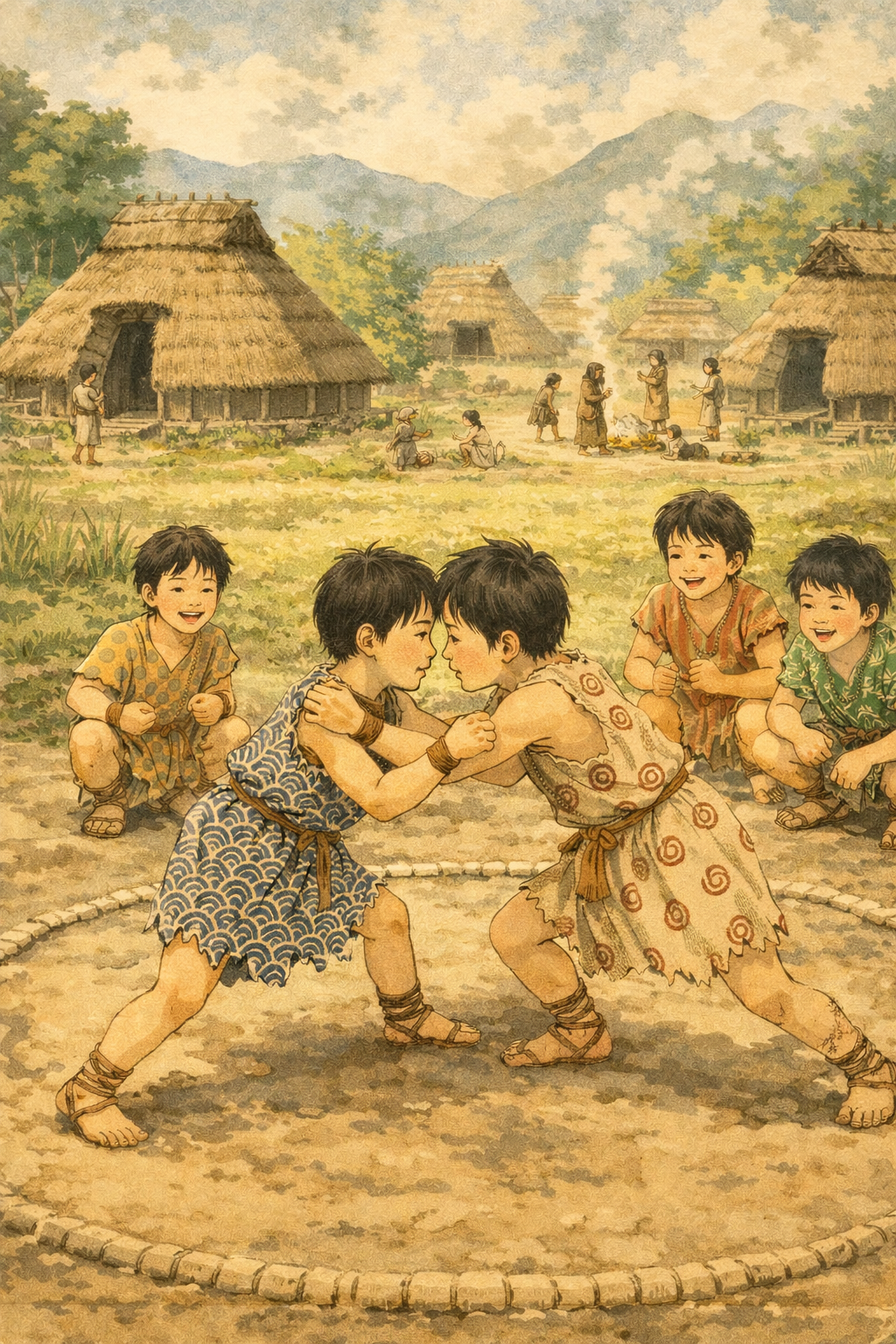
On a hill reached by climbing a steep slope from the shore, there was a large village where about one hundred and fifty people lived. Around a wide open space stood about thirty houses. Each house was small, with a triangular roof and only one room.
The houses were built over deep holes dug into the ground, up to about a person’s waist. Strong posts were set in place, beams were laid across them, and thick layers of dry grass were piled on top to make the roof.
The people had cut down trees to build the village. Oak and chestnut trees still stood around it, but all the trees on the western side had been neatly cleared away. Because of that, the great Mount Fuji could be seen clearly in the open sky.
Every morning and evening, the villagers faced Mount Fuji, put their hands together, and prayed for the safety of their village.
From my village where I was born, Mount Fuji looked much bigger, Soran thought. I wonder what my village is like now. Father died in the war…
Soran and his mother stayed in the village for almost a month. When the villagers learned about their situation, they treated them kindly.
Grandma Yūka, whom they had first met by the sea, invited them to live in her house. She lived there with her husband, just the two of them. Their children were already grown and had built their own homes.
“Soran’s mother really is a hard worker,” Grandma Yūka said cheerfully while spinning hemp thread with her hands. “She brings back lots of fish from the sea every day, and she finds many good plants to eat in the mountains.”
Inside the house, the floor was hard earth, but woven grass mats covered it. There was only one small doorway and one small window to let in light. Thick wooden posts and beams held up the roof, and many thin logs were neatly fitted underneath. The inside of the grass roof had turned black over many years.
In the center of the room was a hearth, with a warm fire burning.
Soran sat by a stone mill, cracking acorns and crushing the nuts inside with another stone.
“My mother can do everything,” Soran said proudly. “She was the fastest swimmer in her village. She was a real tomboy when she was little.”
“Oh my, is that so?” Grandma Yūka laughed, her eyes narrowing kindly.
“And what are you good at, Soran?” she asked.
“Well… I think I like singing,” he said.
“Is that so? Then sing something for me.”
“Okay.”
Soran began to sing his favorite song.
On the beach where small waves come, In the morning, wild roses bloom. In the evening, I think of long ago. Where are my father and mother now? Tell me, oh seagulls.
“That’s a lovely voice,” Grandma Yūka said. “But it’s a sad song.”
“Huh? Is it sad?” Soran asked. He had never really thought about the meaning before.
“It’s a song about remembering parents who grew old and passed away,” she said gently.
“I see…”
“When people grow old, they all return to the earth,” Grandma Yūka continued. “That’s why, while we are alive, we should move, play, and work as much as we can, leaving many footprints behind. If we do, maybe one footprint will remain that rain and wind can never erase.”
She laughed softly and pointed nearby. “Even Tama, curled up over there, has left footprints all around.”
The cat Tama lifted its head when its name was called, then quickly tucked it back into its round body.
“But even if nothing remains,” Grandma Yūka said, “it’s enough to live happily. If you can live with your children and grandchildren and be thankful to the gods, then you can sleep peacefully in the end.”
“Then… is my father sleeping in the earth now?” Soran asked.
“Yes,” she nodded. “Your father left you as his footprint. You should be thankful.”
“So… I’m my father’s footprint,” Soran said quietly. “What kind of footprint will I leave?”
“That depends on you,” Grandma Yūka said warmly. “You should go out into the wide world you don’t yet know. Beyond this sea, there is surely another world where people live.”
She looked at Soran with loving eyes.
“Now then,” she said, smiling, “you’ve helped enough. Go outside and play.”
“Yes!”
Soran’s face lit up with joy.
Outside, it was cold, but many lively children had gathered in the village square. Happy voices echoed everywhere.
The girls were playing a game together, hitting small shuttle-like toys made from hard black seeds with bird feathers attached. They used long wooden paddles to keep them from falling to the ground. Bright red and blue patterns decorated their clothes.
Older boys were helping the grown men build a sumo ring. They piled up earth and packed it down firmly with wooden mallets. After repeating this many times, a strong ring was formed.
The rule was simple: if you fell out of the ring, or if any part of your body other than your feet touched the ground, you lost.
Twice a year, nearby villages gathered for a sumo tournament, once in a cold month and once in a hot month. It was like a festival that the men looked forward to. This time, Fujimi Village was the host.
“Hey, Soran! Come over here!” Masato called out. He was the same age as Soran.
“Let’s do sumo together!”
Other boys quickly gathered.
“Let’s do it!”
“All right!”
They drew a circle on the ground with a stick and made a simple ring. They split into teams of five, and an older boy acted as the referee.
“Ready… go!”
The matches began. Quick children ran left and right inside the circle, trying to push their opponents out. If a big child grabbed you, there was no escape—you would be lifted and thrown out.
Soran wasn’t very big, but he was steady and strong at the waist. He won several matches that way. But this time, he faced Katsuya, a big nine-year-old.
They crouched and faced each other.
“Ready… go!”
At once, Katsuya charged straight at Soran. Soran nearly fell out, but he dodged just in time. Katsuya raised his arms and came again. Soran pushed with all his strength, but Katsuya didn’t move at all.
Then Katsuya leaned his heavy body on top of him, trying to crush him down. Soran felt a great weight on his back, but he shouted, “Eiyaa!” and pushed up with all his might.
Katsuya, caught off guard, fell headfirst onto the ground.
“Ohhh!”
“He did it!”
The children cheered.
“Soran wins!” the referee announced.
Katsuya stood up and praised him. “You got me. You’re strong at the waist. If you practice, you’ll be even stronger. Want to join the children’s sumo at the next tournament?”
Masato put an arm around Soran’s shoulders. “Yeah! If it’s Taro, Toshi, you, me, and Katsuya, we might win!”
Soran nodded happily.
This village is full of good people, he thought.
“Soran, dinner’s ready!” his mother called.
It had grown completely dark, but the children hadn’t noticed at all.
“See you!” Soran waved and ran home.
Inside, the house was warm. The fire burned brightly in the hearth. Tōmo adjusted the fire, and a clay pot of fish soup simmered gently. Millet and foxtail millet had been cooked together, making the soup thick and rich.
Grandma Yūka and Grandpa Jirō smiled happily at Tōmo and Soran. Grandpa was already drinking. He was very tall and loved to talk, so everyone called him Seitaka. He cheerfully ate the salted squid that Tōmo had made.
“Ho-i! You two have become just like our own child and grandchild,” he said. “Tōmo’s cooking is so good. If you like, you could stay here forever.”
“Yes,” Grandma Yūka agreed. “Your village is very far away, isn’t it? You don’t even know if you can get back safely. There’s no need to push yourselves. Tōmo is beautiful—many men would want her as a wife.”
Soran looked at his mother. He liked this village and thought it would be nice to live here. But Tōmo smiled and said gently,
“Thank you so much for your kindness. This really is a wonderful village. But we must return. There are people waiting for me in my home village.”
Grandpa Seitaka suddenly spoke up.
“Ho-i! Your village is called Saku, beyond the high mountains to the west, right?”
“Yes, that’s right,” Tōmo answered.
“Lately, many people have been moving down from the western and northern mountains to warmer lands by the sea. There’s a village about two days’ walk from here, settled by people who moved three years ago. They also came from beyond the western mountains. You might learn something if you ask them.”
Tōmo’s eyes shone. “I’ll do that. I’ll go as soon as spring comes. In my village, the chief once talked about moving to wide land by the sea. That was more than seven years ago… I won’t give up until I find my village.”
Soran spoke honestly. “Mother… if we can’t find our village, we could live here. I’ve made friends. I’d be okay with that.”
Tōmo laughed softly. “I see. You really like this village. We’ve been helped so much here. If we truly can’t find our village, then let’s ask to become part of Fujimi Village.”
“Yes,” Soran said.
He felt a little relieved. Deep down, he had been worried about the long journey ahead.
Please leave a comment!